Note: educational contents can be found at edu.nasiri.fi

Oil and gas


Nasiri Ltd. provides services to any of the sectors of the oil and gas industry. Services include procurement and process design; to find out more about these services please check our service page.


This industry includes major processes of exploration, extraction, refining, and transporting and has three main sectors including upstream, midstream, and downstream.

Upstream: The upstream sector is the furthest from the end-user and includes exploration, drilling, and extraction processes. It involves the search for the fields of crude oil/natural gas and drilling and extraction from underground or seabed. Later the extracted resource is transported to production units via pipelines. The upstream is also known as exploration and production (E&P).

Midstream: midstream sector is the link between the upstream and downstream. It includes gathering, storing, and transporting the resources via pipeline, railway, ship, or tanker truck.

Downstream: The downstream sector is the closest link to the end-users, and it includes refining (in refineries and petrochemical plants) and distribution. The downstream processes convert the resources to finished products like gasoline and diesel. The industry has more than 6000 products and the major ones are fuel oil and gasoline.

Marine and shipbuilding


Nasiri Ltd. provides functional design, industrial automation, and instrumentation services for the Scrubber and SCR. To find out more about these services please check our service page.


Broadly, ships are categorized as cargo and passenger. Cargo ships include container, roll-on/roll-off, bulk, multi-purpose, refrigerated, and tanker ships which are used for transportation of goods and fluids. Passenger ships include cruise and ocean liners that are used to transport people. Shipping is one of the most energy-efficient and economical methods for mass transport of cargo and it is and will remain to be the dominant method in world trade. The shipping industry emits approximately 3.1% of annual CO2, and about 15% and 13% of human-made NOx and SOx respectively, and to a large extent fuel type affects these emissions; additionally, fuel cost accounts for about 50%-60% of the total operational cost. NOx and SOx are harmful components and responsible for ozone-depleting and acid rains.

For maritime safety, the International Maritime Organization (IMO) contains rules about ships in the MARPOL (International Convention for the Prevention of Pollution from Ships). MARPOL sets the limits on NOx and SOx emissions. In 2016, on the 70th session of the Marine Environment Protection Committee (MEPS) meeting, IMO has required ships to cut their emissions of SOx by 80% (reduced from 3.5 wt% to 0.5 wt%) within the Emission Control Areas (ECAs) from 1st of 2020 onward (also referred as IMO 2020).

MARPOL (regulation 13 of Annex VI) sets the emission limits on NOx to be applied on marine diesel engines with an output power of more than 130 kW. The limits depend on the maximum operating speed (n, rpm) which is shown below:
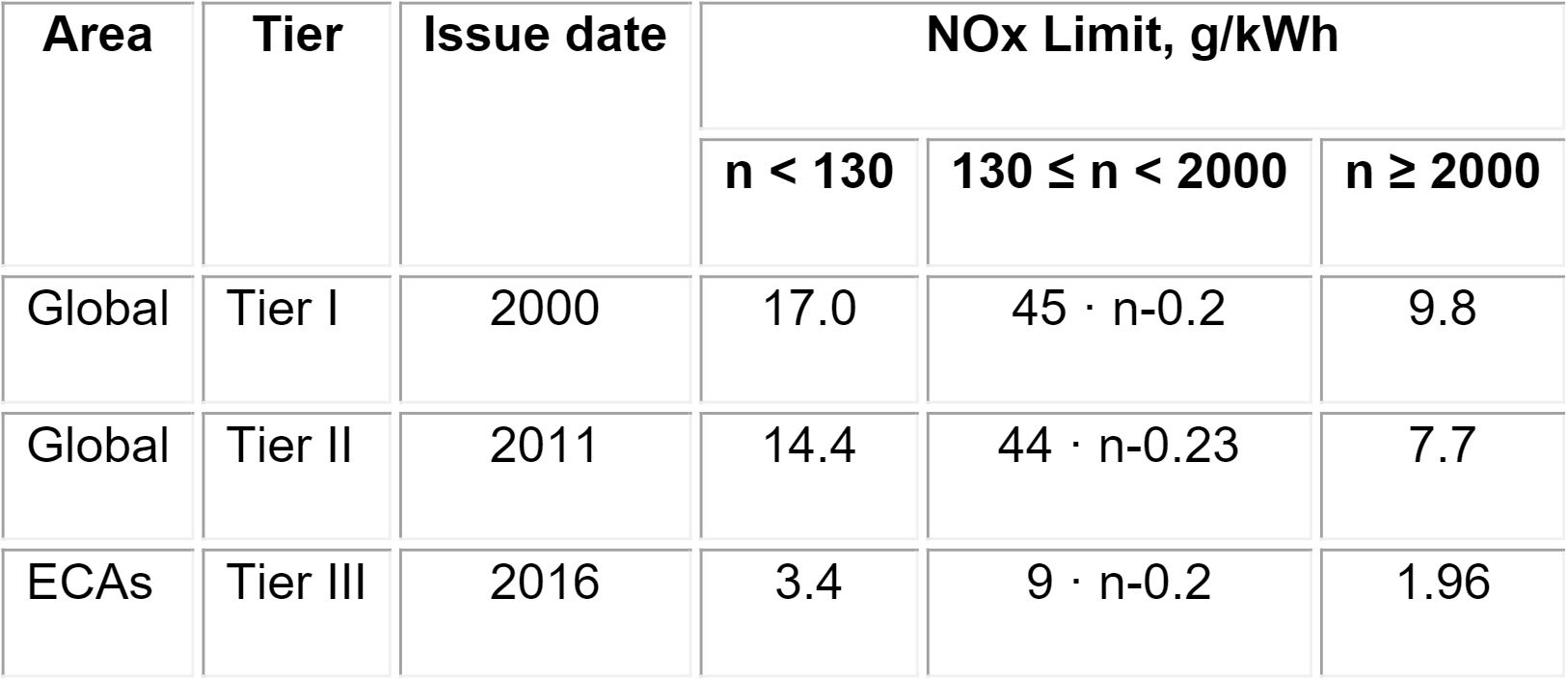

marine_table

With only combustion process optimization, the Tier II can be reached, but Tier III requires NOx emission control technologies. As these regulations are getting tighter, ship owners need to consider lighter fuels like LNG or to look for new standard solutions. The Scrubber system is the best method to remove SOx and it has open-loop and closed-loop modes. In both modes, a scrubber tower is placed in the way of engine exhaust gas to wash out the SOx (and NOx). Unfortunately, in the open-loop mode, the exhaust gas is washed with seawater and this acidic solution is directly dumped back into the sea.


SO2 + H2O → H2SO4 ←→ H+ + HSO4 ←→ 2H+ + SO42


NO2 + H2O → HNO3 ←→ H+ + NO3


However, in the closed-loop mode, the exhaust gas is washed with NaOH solution following the equation below, and the resulting solution is not discharged to the sea directly but is sent to a water treatment unit where the effluent emulsion is treated to be reused or being discharged overboard to the sea. This method can reduce the SOx by 95%.


SO2 (aq) + 2 NaOH (aq) → Na2SO3 (aq) + H2O (l)


The reaction of NaOH with SO2 results in sodium sulfite (Na2SO3) that, according to the material safety data sheet (MSDS), causes little oxygen depletion in aquatic systems if dumped into the sea. To remove the NOx, Selective catalytic reduction (SCR) is the most efficient way to convert NOx into N2 and H2O by using a catalyst. In this method, exhaust gas is blended by urea solution and passed through the catalytic reactor which reduces NOx emission up to 90-95%.

Energy


Nasiri Ltd. provides functional design, industrial automation, and instrumentation services for the power boilers in the energy industry. To find out more about these services please check our service page.


The energy in chemical fuels is most usually released with the process of combustion. Fuels can be burned in natural forms like wood, peat, petroleum, etc., or artificial forms like diesel, black liquor, CNG, etc. Among different types of fuels, biofuel is derived from biomass that releases bioenergy under a controlled environment. Power boilers are one of those units that provide this environment for burning biomass to generate heat in form of steam and power in form of electricity or both together (also referred to as combined heat and power - CHP generation). However, there are advanced power boilers that are flexible in the intake fuels type and can use fossil fuels as a replacement.

Power boilers use fluidized bed technologies to convert the fuel to steam and electricity. The two main technologies are Bubbling Fluidized Bed (BFB) and Circulating Fluidized Bed (CFB); both are following the same principles to transfer the heat energy to water to produce steam. The high pressure and temperature steam are either used directly or being expanded in steam turbines to generate electricity.